US Area Code Lookup
Instantly find factual context, location, and time zone information for any US area code.


Learn More About Area Codes
Popular Area Codes
214
TX (Dallas) | Est. Pop: 6.6M
303
CO (Denver) | Est. Pop: 5.3M
919
NC (Raleigh) | Est. Pop: 4.4M
410
MD (Baltimore) | Est. Pop: 4.3M
706
GA (Columbus) | Est. Pop: 4.1M
512
TX (Austin) | Est. Pop: 3.8M
704
NC (Charlotte) | Est. Pop: 3.6M
503
OR (Portland) | Est. Pop: 3.4M
540
VA (Roanoke) | Est. Pop: 3.3M
321
FL (Orlando) | Est. Pop: 3.3M
615
TN (Nashville) | Est. Pop: 3.1M
336
NC (Greensboro) | Est. Pop: 3.1M
Frequently Asked Questions
Common questions about how US area codes work, why they change, and what they can tell you about a phone number.
A US area code is the three-digit prefix of a 10-digit North American phone number. It was introduced as part of the North American Numbering Plan (NANP) in 1947 to enable direct long-distance dialing without operator assistance. An area code identifies the geographic region where a phone number was originally assigned — it tells you the state or metropolitan area, but not the caller's current physical location, since mobile users keep their number when they move.
The US currently has 374 in-service area codes (376 in our database), and the number continues to grow. When the NANP launched in 1947 it assigned 86 codes in total (77 in the US). As demand for phone numbers surged — driven by fax machines, pagers, dial-up internet, and later mobile phones — new codes were introduced through splits and overlays. NANPA (the North American Numbering Plan Administration) projects and manages future exhaustion dates for each numbering plan area.
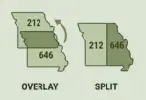
A split divides an existing area code's territory into two or more geographic zones, each getting its own code — residents in the carved-off zone receive a new area code. An overlay adds a second (or third) area code to the exact same geographic territory, so neighbors can have different area codes. Overlays are now the standard method because they let existing customers keep their numbers. Both methods require 10-digit dialing. See our overlay vs split guide for a detailed comparison.
When an area's pool of available seven-digit number combinations runs low, regulators introduce an overlay — a new area code layered on top of the same geography. This means two businesses on the same street can have different area codes. Overlays became the preferred approach in the 2000s because, unlike splits, they don't force existing subscribers to change their numbers. The trade-off is mandatory 10-digit dialing for all local calls.
An area code narrows a call to the state or metro area where the number was originally provisioned, but it does not reliably indicate the caller's current location. Mobile users retain their number when they relocate, businesses use numbers from regions where they have no office, and VoIP services can provision numbers from virtually any area code. Area code lookup is useful for understanding general geographic context, not for pinpointing a caller's real-time whereabouts.
Ten-digit dialing means you must dial the full area code plus the seven-digit number for every call, even local ones. The FCC designated 988 as the Suicide & Crisis Lifeline in July 2020, which required 10-digit dialing in any area where 988 was an active prefix — even without an overlay — ahead of the Lifeline's nationwide launch in July 2022. In overlay areas, 10-digit dialing was already necessary because multiple area codes share the same territory and the network needs all 10 digits to route correctly.
New area codes are planned years in advance by state public utility commissions, working with NANPA. When a numbering plan area (NPA) is projected to exhaust its available number combinations, NANPA initiates a relief process. Stakeholders — carriers, regulators, and the public — weigh options (overlay vs. split), then a new three-digit code is selected from the pool of unassigned codes. The new code is announced, carriers update their routing tables, and a permissive dialing period lets customers adjust before the change becomes mandatory.
The original 86 NANP area codes (77 in the US) were established in 1947 when AT&T and Bell Labs designed the NANP. Codes followed a pattern: states with a single code got a middle digit of 0 (e.g., 207 for Maine), while multi-code states used 1 as the middle digit (e.g., 212 for New York). Many originals — like 212 (New York City), 312 (Chicago), 213 (Los Angeles), and 415 (San Francisco) — remain active today, though most have been split or received overlays to meet growing demand. You can look up any area code on our site to see whether it is an original or a later addition.